
Dozier Arkansas Made Modified Personal
Item #: DK-MP2GBE
$325.00
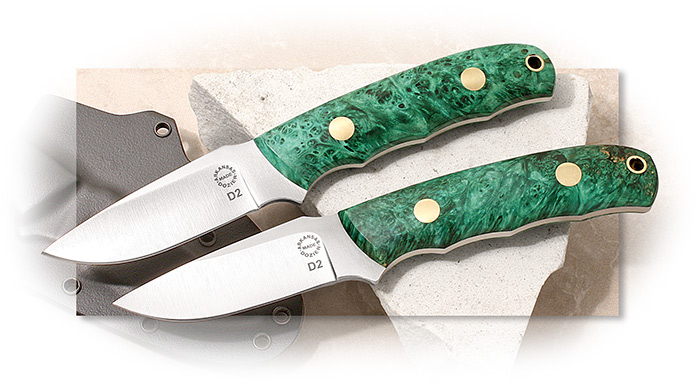
with Green Box Elder & Horizontal Sheath
In 2012, we revived the Dozier Modified Personal which the Dozier shop had made for a short time in 2003. It has been very popular with Desert Ironwood and with A.G.'s Ebony Rucarta for handle scales.
We have a small quantity of the Green Box Elder that we have recently offered on several other models. I gave some of that to the Dozier shop and asked that they use it on the Modified Person. The knives the shop delivered are beautiful. If you like the color, you won't go wrong with these knives.
The 3" drop point blade is D2 at 60-61 Rc., with Dozier's own heat treat for the absolute best cutting edge you can buy. The blade design allows this small, inconspicuous knife to function as well as a much larger knife. The step at the back of the blade allows the user to apply pressure to increase the cutting function of the knife. Measures 6-7/8" tip to butt. Weighs 3.5 oz. Includes a Dozier horizontal Kydex® sheath individually fitted to each knife. Handmade in Springdale, Arkansas.
-
TypeFixed
-
BladeDrop Point
-
Blade Length3"
-
FinishSatin
-
Blade SteelD2
-
Rockwell60-61
-
HandleGreen Box Elder
-
TangFull
-
Overall Length6-7/8"
-
Weight3.5 oz.
-
SheathKydex
-
OriginUSA
Arkansas Made Dozier
Bob Dozier made his first knives when he was only twelve or thirteen years old. He told me the other day that after those few knives, he did not make another until he was about twenty-three and working as a rough neck in the oil fields in Louisiana. He talked about that first simple knife and then told a story about a co-worker asking to come to watch him make knives. Bob had made several knives by then and had created a small rough shop. He said the man stayed and watched until the knife was finished which took most of the day. When it was finished, he asked to look at it. After handling it for a while, he asked Bob how much he wanted for it. Without giving it any thought, Bob says he said $12.50. The man pulled out twelve one dollar bills and two quarters, laid them on the bench, got in his truck and left. Bob went in the house and told his wife he had just sold a knife which took him most of the day to make for $12.50. But, he told me, at that moment he knew he was going to be a knifemaker. That was about 1963.
If you had the opportunity to look through Bob’s collection of his old knives, you would find that he has made many different kinds of knives; hunters, Bowies and fighters, and more recently folders. You can definitely see a relationship between a pair of fighting knives he made in those early years and the practical, utilitarian fighters that began to appear from handmade knifemakers and knife manufactures from the late 1960s and became tremendously popular during the Viet Nam War era. These knives used to be called fighting knives. Today they are called Tactical Knives.
Dozier Arkansas Made Modified Personal
